T Handle Lock Buyer's Guide: How to Choose for Garage, RV & Truck Doors
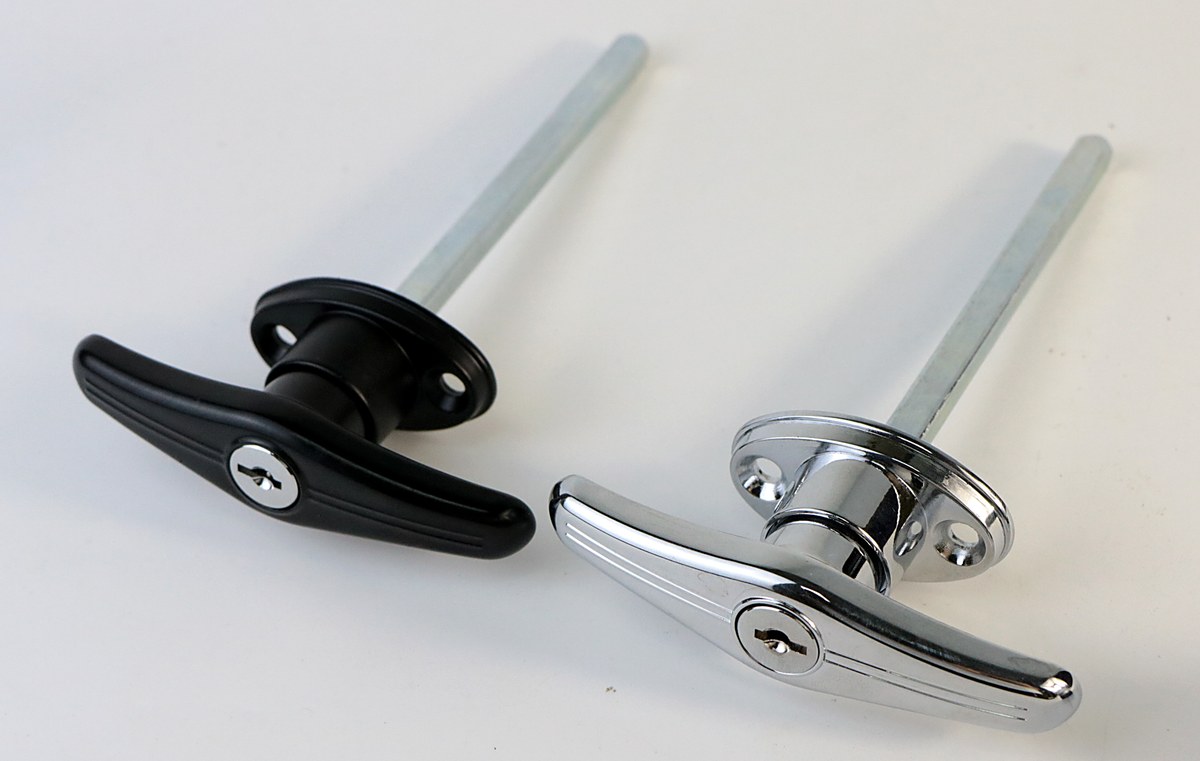
A T handle lock (also called a T-bar handle lock or T handle latch) is a surface-mounted locking handle shaped like the letter "T". It is installed directly into a door or panel — garage doors, RV doors, truck doors, trailers and utility cabinets — and locks by turning the handle to drive a square shaft (spindle) that engages a latch or cam on the inside of the door.
Unlike a padlock, which is portable and used to secure a hasp, a T handle lock is a permanent piece of door hardware. It replaces the door's original handle and combines the handle function and the locking function in one unit.
Where T Handle Locks Are Used
Five common applications:
- Garage doors — residential and commercial, where the T handle drives the locking bars on the inside of the door.
- RV and camper doors — must withstand constant vibration and weather exposure.
- Truck and service body doors — dust, vibration, and heavy everyday use.
- Trailers — enclosed trailers and semi-trailer doors.
- Utility and industrial cabinets — surface-mounted keyed handles on tool boxes and equipment cabinets.
4 Things to Check Before You Buy
1. Square shaft length — the #1 cause of wrong orders
The square shaft (spindle) is the rod that passes through the door and drives the latch. It must be long enough to pass through your door thickness plus the latch mechanism, with enough left to engage properly.
- Common sizes: 5/16 in. × 4-5/8 in. (about 8 mm × 118 mm), or longer 127 mm shafts for thicker doors.
- If the shaft is too short, the lock won't engage. If it is too long, it can usually be cut to size — but confirm this with your supplier first.
Always measure your door thickness and the depth of your latch before ordering.
2. Material — zinc alloy
The body of a durable T handle lock is die-cast zinc alloy. It is strong, rust-resistant when plated or coated, and holds up to outdoor weather, vibration and temperature changes — the conditions garage, RV and truck doors face every day.
3. Surface finish — chrome vs. powder-coated black
- Chrome plated — bright and corrosion-resistant. Good for garage doors where appearance matters. Salt-spray tested to 24 hours.
- Powder-coated black — matte finish. Better for industrial and heavy-duty use where scratches and grime are expected (truck doors, service bodies). Salt-spray tested to 72 hours.
4. Keying — KA vs. KD
- KA (Keyed Alike) — all locks open with the same key. Ideal for fleets or multiple doors managed by one person.
- KD (Keyed Different) — each lock has its own key. Better when different people need separate access.
A good supplier offers both. If you manage a fleet of trucks or lockers, KA keying can save a lot of key management.
Common Problems & How to Avoid Them
- Rust seizing the lock → choose zinc alloy with plating or powder coating, plus a salt-spray test.
- Shaft too short → measure your door thickness and latch depth before ordering.
- Lost keys, poor key management → order KA (keyed alike) for fleet use.
- Vibration loosening (RV/truck) → full-metal construction.
Why OEM Buyers Should Check the Supplier, Not Just the Price
For a door factory or vehicle builder buying T handle locks in bulk, the lock is a component in your product. A failed lock becomes a warranty claim on your product. Before ordering, confirm:
- Is the body zinc alloy?
- What shaft lengths and finishes are available?
- Can they do KA/KD keying and custom logo?
- What is the MOQ and sample lead time?
A factory that answers these clearly — with real specifications, not marketing language — is the one to work with.
Need T handle locks for your doors? We'll recommend the right shaft length and finish.
Get a Quote →